The Lincoln Center Festival was a prominent summer festival here in the city. It started in 1996 and ended in 2017. The Mostly Mozart Festival has been around, in some form, since 1966. With the folding of the Lincoln Center Festival, Mostly Mozart expanded in duration and scope. I will provide a little sampler of the 2019 offerings.
Mostly Mozart presented an opera that is all Mozart—The Magic Flute. The venue was the David H. Koch Theater, on the Lincoln Center campus. The place was packed the night I was there. Alice Tully Hall had been too, the previous Sunday afternoon. On that occasion, the Chamber Music Society of Lincoln Center presented—what else?—a chamber concert. There is a hunger for classical music in New York City, even on lazy summer days.
Of course, you could say that, in a city of eight and a half million, there’s always a significant hunger, for anything.
The Magic Flute was conducted by Louis Langrée, who has been the music director of the Mostly Mozart Festival since 2003. He was preceded by Gerard Schwarz. Mostly Mozart has been very, very fortunate in its music directors.
More than once, I have said that Langrée is a better conductor than his orchestra. I further say that I would rather hear a first-rate conductor with a second-rate orchestra than a second-rate conductor with a first-rate orchestra. The conductor is the more important actor. Regardless, the Mostly Mozart Festival Orchestra has improved considerably in recent years.
Before the overture, I was a little anxious—because the fashion today is to race through the overture. By conductor after conductor, the overture is taken so fast, there is no enjoyment in it, and no Mozart. Langrée was not guilty of this error. His tempo was brisk but not nuts. The music was energetic, not manic. There was room for Mozartean grace. Furthermore, the overture was a commendable weight, if I may: not period-band light and certainly not swollen. You know the good, solid Mozart that Neville Marriner conducted? That’s the kind of thing I’m talking about.
Throughout the opera, Langrée demonstrated intelligent phrasing. He maintained the composer’s tensions. The orchestra showed it could articulate. It could not do everything, however. Act II begins with a little F-major hymn, as I think of it. Formally, it is the “March of the Priests,” but it is still hymn-like, in my book, as perhaps a priestly march should be. The festival orchestra could not summon the warmth desirable for this music—but the orchestra was adequate, and more than, in the various sections of the opera. And it is a pleasure to hear Langrée conduct Mozart.
As for the cast, it was composed of unknowns. But when people say “unknowns,” what do they mean? Usually that they themselves have never heard of them. Everyone is known to someone. In any case, it was a strong cast, and a youthful one, as befits this opera. If there was not a Wunderlich, Röschmann, or Prey in this bunch, neither was there a lemon.
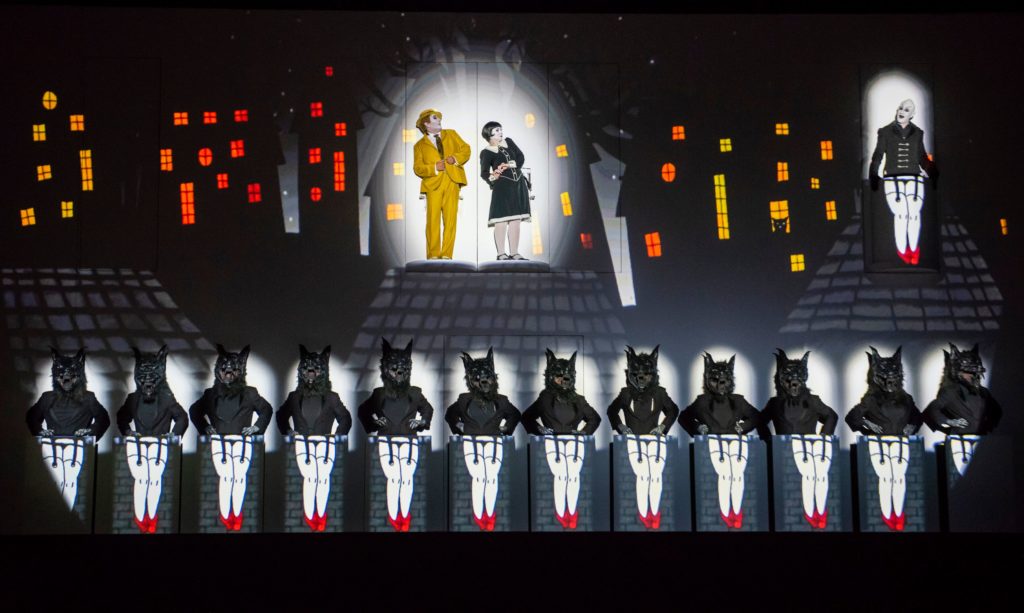
This is a smart, clever, enjoyable, imaginative production. It is filled with videos, or animation. It is funny too, with some outright “lolz”: people laughed out loud, all around me.
The production came from the Komische Oper Berlin, and it was co-directed by Suzanne Andrade and Barrie Kosky. This is a smart, clever, enjoyable, imaginative production. It is filled with videos, or animation. It is funny too, with some outright “lolz”: people laughed out loud, all around me. The production takes its inspiration from the silent movies. For example, the characters do not engage in the spoken dialogue written for them; instead, the dialogue appears on a screen, as the characters mug and so on. Meanwhile, a fortepiano plays. (Specifically, the music is two of Mozart’s fantasies, K. 397 and K. 475.)
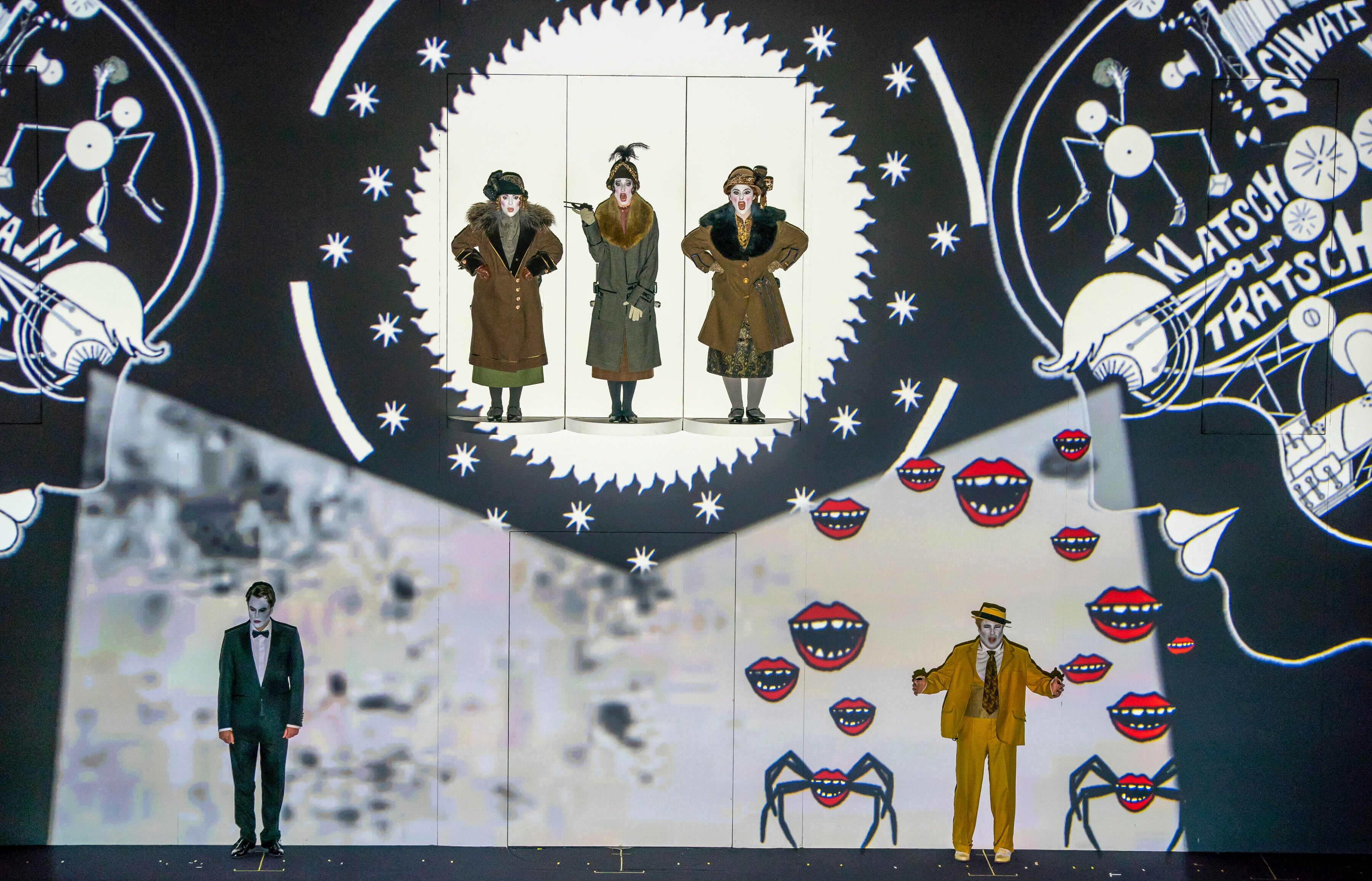
Let me mention a particular character—Monostatos, the chief of the slaves. In some productions, he is portrayed in blackface, which is, of course, problematic. In this one, he is portrayed in whiteface.
The production is very, very busy—flitty. Is it distracting? That is in the eye of the beholder, I suppose. To my eye, and ear, the production distracted from the music. The music was a mere soundtrack to the show. I thought of mtv, from way back. On that network, the video was more important than the song. Earlier this year, Andrew Ferguson wrote an essay for The Atlantic, in praise of print newspapers over their websites. His print edition would “hold still,” he said; the websites do not. They often go off like pinball machines. This production of The Magic Flute does not hold still. I sometimes looked away, so I could listen to the music.
Also, the production is very, very jokey—nothing is sacred. The Magic Flute is a jokey opera, no doubt, or at least one laced with humor. But there are also streaks of the sacred. The production does not really honor the sacred. When Sarastro began “In diesen heil’gen Hallen”—a fairly holy aria—I looked away.
I left midway through Act II. I admired the production, but, at the same time, it hurt my eyes, and I had had enough. I have no doubt this was a minority opinion.
When it comes to productions of The Magic Flute—I remember doing this when Julie Taymor’s production bowed at the Metropolitan Opera in 2004—I always ask, “What would Mozart and Schikaneder think?” (The latter is Emanuel Schikaneder, the librettist of The Magic Flute.) I think they would be amazed, impressed, and delighted by the Komische Oper Berlin production. I also think they would say: De trop (or its German equivalent). Don’t smother the music and words.
Before moving on to a concert, let me pay tribute to this masterpiece, The Magic Flute, by telling a story: I once asked Andrew Porter, the eminent music critic and scholar, a silly question: “What is your favorite opera?” He did not regard it as silly, fortunately. Almost before the words were out of my mouth, he said, “The Magic Flute.”
The concert was an orchestra concert, conducted, not by Louis Langrée, but by Andrew Manze. The first line of his bio tells us that he “is widely celebrated as one of the most stimulating and inspirational conductors of his generation.” This, ladies and gentlemen . . . is not true. The language of musicians’ bios, cooked up by publicists, is absurd. Musicians themselves should rebel against it, for their own dignity. Regardless, Maestro Manze is a very good conductor. That should be enough.
His bio might tell us what town he is from or whom he studied with. It might at least tell us his nationality. Of course, this bio does none of that. They seldom do, musicians’ bios. (Manze is English, by the way.)
Leading off the concert was Beethoven’s Violin Concerto, in which the soloist was Vilde Frang, a young Norwegian. She is a touching, noble artist. I usually shun the word “artist” when speaking of musicians, because I regard it as frou-frou, pretentious. But to some, it applies.
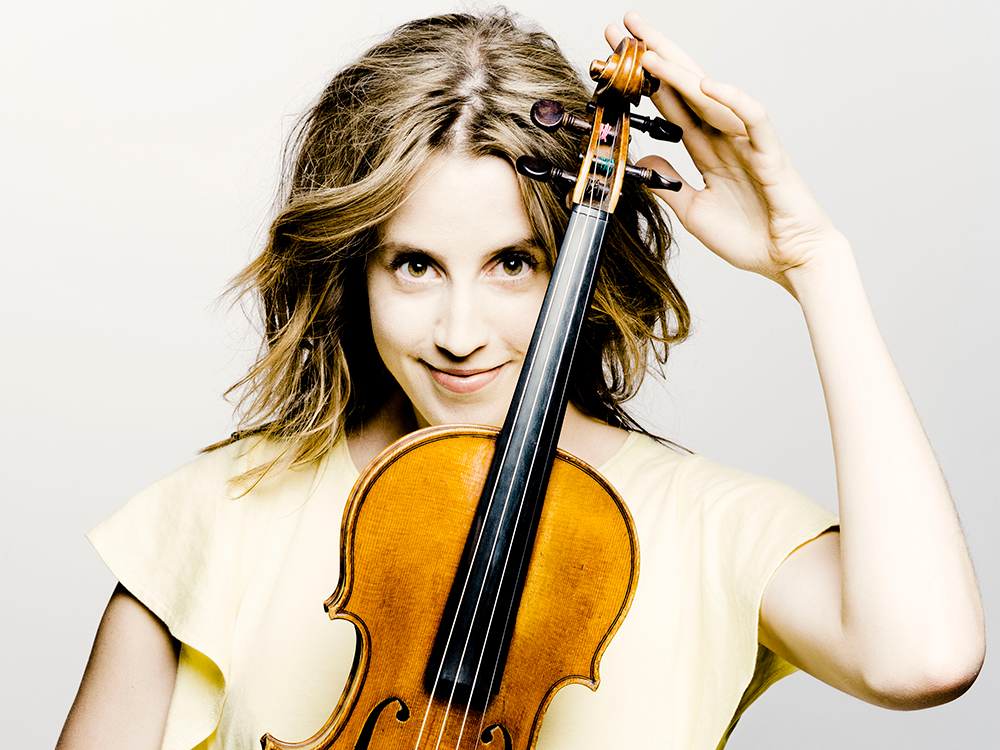
Manze conducted the exposition in masterly fashion—like a conductor who should be widely celebrated as one of the most stimulating and inspirational . . . oh, never mind. The music was tight, masculine, incisive, uplifting, and thoroughly Beethoven-like. The soloist, incidentally, has to stand around for a long time before she plays. This can be awkward for her. A pianist can simply stare straight ahead, if he wants: as in Chopin’s E-minor concerto, which has a long, long orchestral introduction. But what does a violinist, who faces the audience, more or less, do? Frang sometimes looked left and into the orchestra; and then the other way, into the orchestra. She passed the time. In any event, this is a peculiar issue of stage comportment.
When she finally entered, Frang played her Beethoven with sweetness, reverence, and love. Her playing was rather inward and small; she did not make her violin try to do too much. The cadenza was almost like a private meditation. (Frang played Kreisler’s.) In comedy, we speak of “timing,” although we usually leave this word out of music. Frang has great timing—a sense of rhythm, of rubato, of wholeness, and flexibility within that wholeness.
Let me say, too, that the orchestra’s entrances were unusually precise. This is to Andrew Manze’s credit. And the principal bassoon, Marc Goldberg, made an outstanding—an outstandingly musical—contribution.
In the middle movement, Larghetto, Frang was melting and elastic, following Beethoven’s contours wherever he went. Soon, she was singing like a coloratura soprano. Her trilling was exemplary. Even while she was Romantic, she did not allow the music to dissolve into soup. She bore in mind the pulse. Her purity and beauty were memorable. If Beethoven had been there, he might have said, “Is my Larghetto really as beautiful as all that?”
Under Manze’s baton, even the orchestra’s pizzicatos were together—which is practically asking too much.
Frang effected a nifty transition into the Rondo. She was puckish and alert. She took the Rondo faster than you normally hear it, making me check the tempo marking: Beethoven did not give one, apparently. Frang made me think that other players take the Rondo too slowly. She was not too fast, however. With the orchestra, she was suspenseful and exciting. She made some mistakes along the way—wrong notes—but these were plums in the pudding, and reminders that we were not listening to a studio recording. In a high register, she was glass-like. And Mr. Goldberg, the bassoonist, once more made a nice assist.
I have a complaint, a complaint I have made about performances of this concerto before: I believe that the final notes should be in tempo—and that a ritard violates the character of the music. Frang and Manze went in for a ritard, leaving me with a sour note.
If someone asked you, “What is Beethoven?” you could do worse than to show him the Violin Concerto.
Yet this was a heartening performance, as the audience agreed. They brought Vilde Frang back repeatedly, but she played no encore—not a Bach sarabande, not anything. This was classy, I thought. Concerto soloists are too promiscuous with encores, and Beethoven’s piece needs no supplement. Indeed, it is one of his best pieces, which is saying something, considering the piano sonatas, the string quartets, the symphonies, the Missa solemnis, etc. If someone asked you, “What is Beethoven?” you could do worse than to show him the Violin Concerto.
After orchestra concerts, the Mostly Mozart Festival often presents a little nightcap, a recital, lasting about an hour, without intermission. These events are held in the Stanley H. Kaplan Penthouse, up in the sky, with city lights all around. The events fall under the category “A Little Night Music”—get it? (The name comes from a famous serenade by Mozart.) One of the recitalists was Michael Brown, an American pianist. He played three sets of variations—the first of which was by Mendelssohn, the Variations sérieuses in D minor, Op. 54.
Musical fashion is funny. Once, these “serious variations” were a staple. Everyone played them. Then they virtually disappeared from the stage. I was glad Brown revived them, but his concept of the piece is different from mine (as is his perfect right). He played the music rather more percussively than I would have liked—with more punch and less legato. But you could not fault him for vigor and dash.
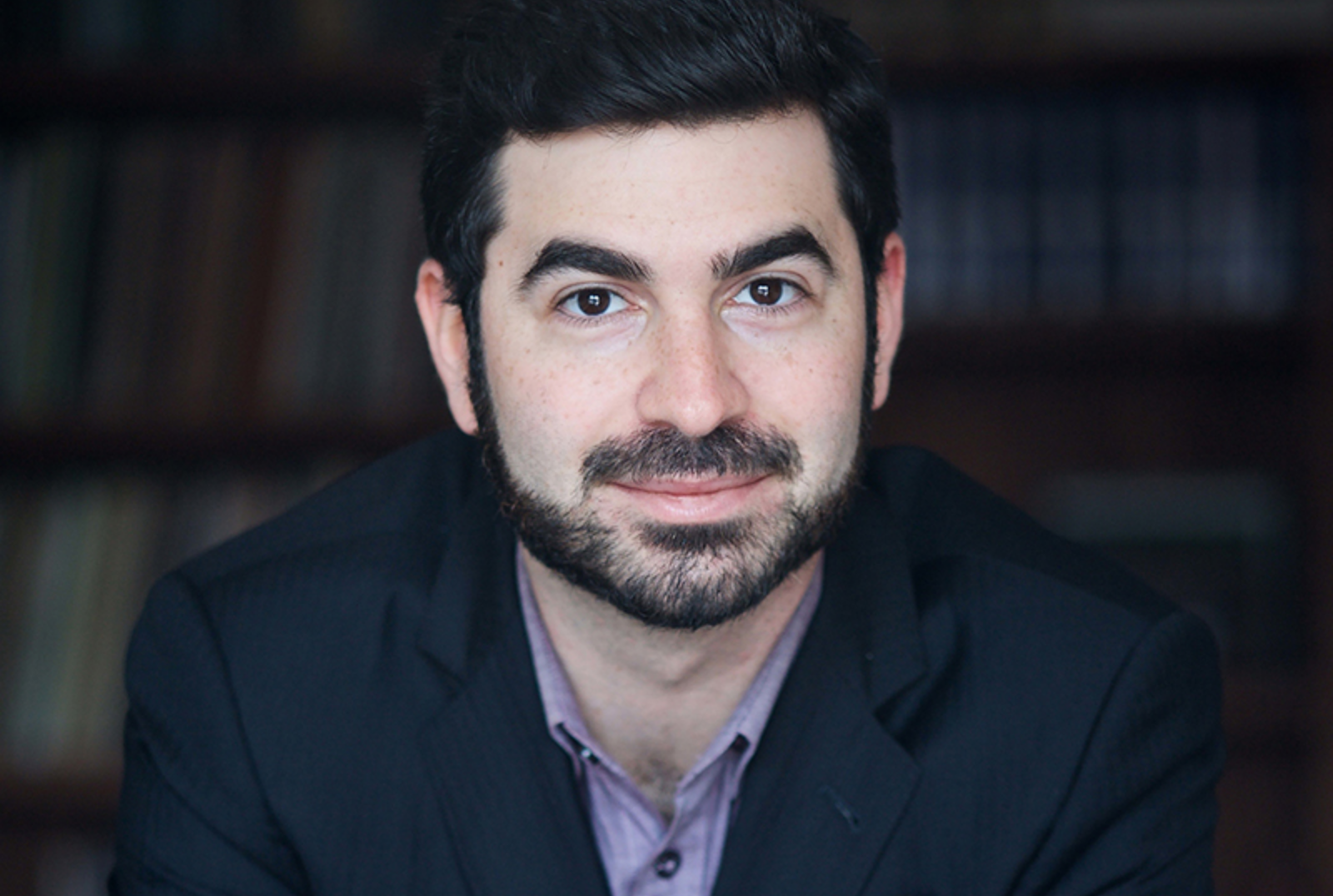
Next came a piece written in 2013: Folk Variations. By whom? By Brown himself. And why the “Folk”? In a chat with the audience, the composer said that he had “Yankee Doodle” in mind—though we would not hear it, and he couldn’t hear it either, for that matter. I did not fully understand the point. At any rate, the piece is so much doodling, noodling, and jamming, or so it seemed to me. The main thing, though, is that Brown rolls his own. That he composes. I appreciate this in a musician, especially in a pianist, I think. Hamelin, Hough, Tao, Brown—they roll their own, and good for them. Their forebears did the same, as they were expected to do.
Mr. Brown ended the printed program with a big piece, the “Eroica” Variations of Beethoven. This work, too, has all but fallen out of the repertoire. I myself associate it with Gilels. In playing it, Brown was fulfilling “thematic programming,” in that the Mostly Mozart Festival Orchestra, a couple of hours earlier, had played Beethoven’s “Eroica” Symphony. Is it sinful to say that I like the piano variations as much as I do the symphony, if not (a little bit) more?
Brown played these variations with command. He showed a clear sense of structure, and he played with total confidence. Boldness. He was unhesitating in everything he did, as if there were no other way. This is a valuable quality in a musician. Brown struck me as a leader, as he played. I wonder whether he conducts, or will conduct, in addition to playing and composing.
The audience wanted an encore, and Brown gave them one, and then another. First, he returned to Mendelssohn for “Spinning Song.” I associate this piece with Rachmaninoff—he made what I believe is my favorite recording of it. Brown could have used more fluidity, I think, but he brought off the piece nicely. He closed with some Fauré, the Nocturne No. 3. Rubinstein used to play it. De Larrocha played it, and many others. I hadn’t heard it in ages. What a lovely, thoughtful send-off.
In David Geffen Hall, there was another orchestra concert, but this time the orchestra was not the mmfo but a guest, a foreigner—the bfo, i.e., the Budapest Festival Orchestra. It was founded in 1983 by Iván Fischer and Zoltán Kocsis, the late genius pianist. The Fischer family has two conductors, the other being Ádám, who is Iván’s older brother. Fischer (Iván) conducted the New York concert—which began with Haydn, his Symphony No. 88 in G. This is one of the most popular of all Haydn symphonies (104), and deservedly so. It is like a summation of everything that is great about Haydn: his humor, nobility, creativity, humanity, and so on.
Let me say that I associate Haydn symphonies with Hungary in this way: a lot of us learned them—the 104—from the famous, pathbreaking recordings of the Philharmonia Hungarica, conducted by Antal Doráti.
In David Geffen Hall, Fischer and the bfo gave us a decent No. 88. Best, I think, was the rusticity in the Trio. Also, the Finale—Allegro con spirito—was nicely unhurried. Remember, “allegro” is a mood as much as it is a tempo (indicating happiness, as you know). Speaking of this last movement: people enjoy going to YouTube and seeing Leonard Bernstein conduct it—or rather, not conduct it: he lets the Vienna Philharmonic play, mainly on their own, enjoying what they do, while occasionally leading them with a nod or such.
Next onstage came Jeanine De Bique, a singer, a soprano, from Trinidad and Tobago. She was stunning in appearance, wearing a red strapless dress. The young woman—a singer—sitting next to me said, “That’s the fun part of being a singer: you get to wear a ballgown to your concert.” Miss De Bique sang three Handel arias, two from operas and one from an oratorio. She began with “Ritorna, o caro,” from the opera Rodelinda. Her sound was slight but pleasing, and her rendering was tentative but sincere. It turned out she was just warming up. The next two arias called on her coloratura—her agility—and she came into her own, wowing the audience.
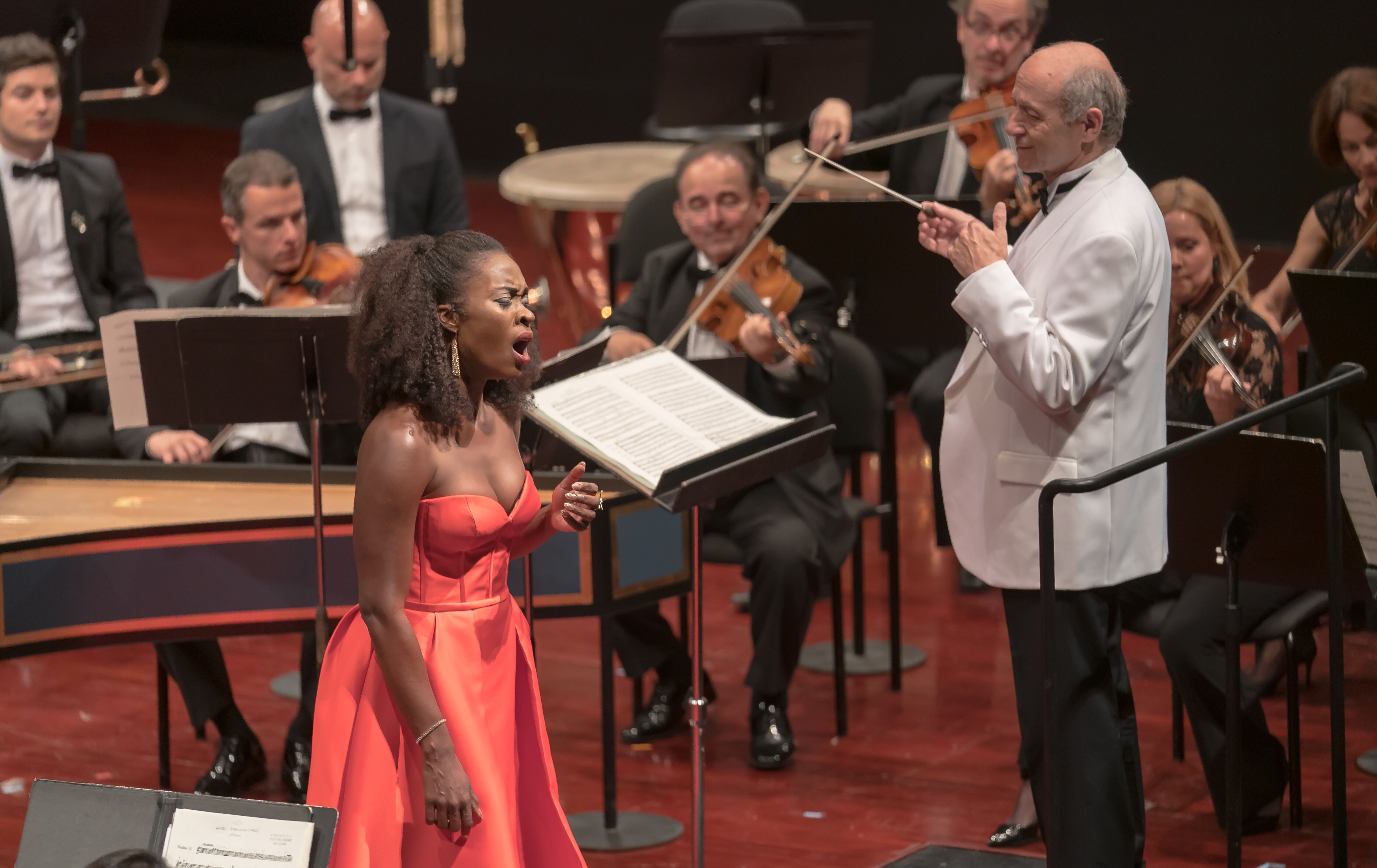
It is fitting that the man himself—Mozart—should have the last word in this chronicle, which has sampled a (mostly) Mozart festival. After intermission, Fischer and the bfo gave us the “Jupiter” Symphony, Mozart’s last. I always point out—annoyingly, I suspect—that Mozart didn’t intend for this symphony to be his last. It was merely his latest. But, if you’re going to end on one, this is a very, very good one to end on.
The performance on this occasion was workmanlike, I would say—sometimes rising to a greater height, as it did in the entire second movement, which is marked Andante cantabile. This means a singing andante. And I have seldom heard this movement so lyrical, so songful. Throughout the symphony, a player in the woodwind section shone: she was Gabriella Pivon, and she played a magic flute, to borrow a phrase. She and the conductor, Maestro Fischer, are married (literally so, not just musically united).
Actually, give someone else, Dvořák, the last word. When it comes to encores, Fischer likes to have his orchestra sing, and he asked the ladies of the orchestra—as he put it in introductory remarks to the audience—to stand and sing an arrangement of one of Dvořák’s Moravian Duets, as the rest of the orchestra accompanied them. I thought of Schwarzkopf and Seefried, on an emi recording, from way back. What a pleasant, offbeat tradition Iván Fischer has established.